Unsupervised Trees: Predictive Clustering & Anomaly Triage
This guide details mltreelib's unsupervised tree architectures—unifying Predictive Clustering Trees (PCT) for interpretable multi-target segmentation with rule extraction and Extended Isolation Forests (EIF) for artifact-free operational anomaly detection.
Script: examples/unsupervised_trees.py (uv run python examples/unsupervised_trees.py).
1. Domain Context & Architectural Rationale
Unsupervised learning and operational triage traditionally rely on distance-based heuristics (such as \(k\)-means, DBSCAN, or standard Isolation Forests). In regulated and industrial deployments, these methods exhibit two major failure modes:
- Uninterpretable Cluster Boundaries: \(k\)-means and GMMs produce soft Voronoi centroids that cannot be translated into auditable decision rules. A domain expert cannot inspect why an applicant or chemical mixture was assigned to a given cluster without evaluating global distance metrics.
- Axis-Aligned Ghost Anomalies: Standard Isolation Forests isolate outliers by sampling cuts parallel to feature coordinate axes. In multi-modal or correlated distributions, axis-aligned cuts create artificial rectangular bands of low average path length, producing false-positive "ghost" anomalies in empty regions between inlier clusters.
mltreelib unifies unsupervised learning through specialized tree engines:
- Predictive Clustering Trees (ClusterTree(kind="pct")): Partitions feature space by maximizing multi-target variance reduction across all covariates simultaneously, yielding transparent, human-readable rule bounding boxes.
- Extended Isolation Forest (AnomalyTree(kind="eif")): Cuts feature space along random oblique hyperplanes with uniformly sampled normal vectors, producing smooth, rotationally invariant anomaly score contours that eliminate ghost artifacts.
flowchart TD
    subgraph Clustering["ClusterTree (kind='pct' | 'cltree')"]
        direction TB
        C1["Unlabeled Data Matrix"] --> C2{"Divisive Variance Reduction\nacross Multi-Targets"}
        C2 --> C3["Terminal Cluster Partitions\n(n_clusters discovered)"]
        C3 --> C4["Interpretable Rule Extraction\n(e.g., alcohol > 10.5 & volatile_acidity <= 0.4)"]
    end

    subgraph Anomaly["AnomalyTree (kind='eif' | 'isolation')"]
        direction TB
        A1["Telemetry Observations"] --> A2{"Oblique Hyperplane Sampling\nw · (x - p) <= 0"}
        A2 --> A3["Path Length Aggregation h(x)"]
        A3 --> A4["Continuous Anomaly Score s(x, n)\n(Rotationally Invariant Contours)"]
    end

    classDef dataBox fill:#1e293b,stroke:#475569,stroke-width:2px,color:#ffffff;
    classDef splitBox fill:#b45309,stroke:#d97706,stroke-width:2px,color:#ffffff;
    classDef nodeBox fill:#1e3a5f,stroke:#2b4c7e,stroke-width:2px,color:#ffffff;
    classDef ruleBox fill:#065f46,stroke:#059669,stroke-width:2px,color:#ffffff;
    classDef anomBox fill:#881337,stroke:#9f1239,stroke-width:2px,color:#ffffff;

    class C1,A1 dataBox;
    class C2,A2 splitBox;
    class C3,A3 nodeBox;
    class C4 ruleBox;
    class A4 anomBox;
2. Benchmark Study: Wine Quality & Multimodal Anomaly Mixture
We evaluate clustering on the Wine Quality benchmark (chemical attributes: fixed acidity, volatile acidity, citric acid, residual sugar, chlorides, alcohol) and anomaly scoring on a 2D multimodal mixture with peripheral outliers.
from mltreelib import AnomalyTree, ClusterTree, load_dataset

# 1. Predictive Clustering Trees (PCT) on Wine Quality
data = load_dataset("wine_quality")
features = ["fixed_acidity", "volatile_acidity", "citric_acid", "residual_sugar", "chlorides", "alcohol"]
X_wine = [[float(data["columns"][c][i]) for c in features] for i in range(1500)]

pct = ClusterTree(kind="pct", max_depth=3, min_rows=30)
pct.fit(X_wine, col_names=features)

print(f"Discovered clusters: {pct.n_clusters_}")
for idx, rule in enumerate(pct.rules()[:2]):
    print(f"Cluster {idx} rule: {rule['predicate']}")

# 2. Extended Isolation Forest (EIF) with oblique hyperplanes
eif = AnomalyTree(kind="eif", max_depth=8, extension_level=1, seed=42)
eif.fit(X_2d, col_names=["x1", "x2"])
scores = eif.score_samples(X_query)
3. Empirical Results: Cluster Partitions & Anomaly Contours
=== 1. Predictive Clustering Trees (PCT) on Wine Quality ===
Loaded Wine Quality dataset: 1500 samples, features: ['fixed_acidity', 'volatile_acidity', 'citric_acid', 'residual_sugar', 'chlorides', 'alcohol']
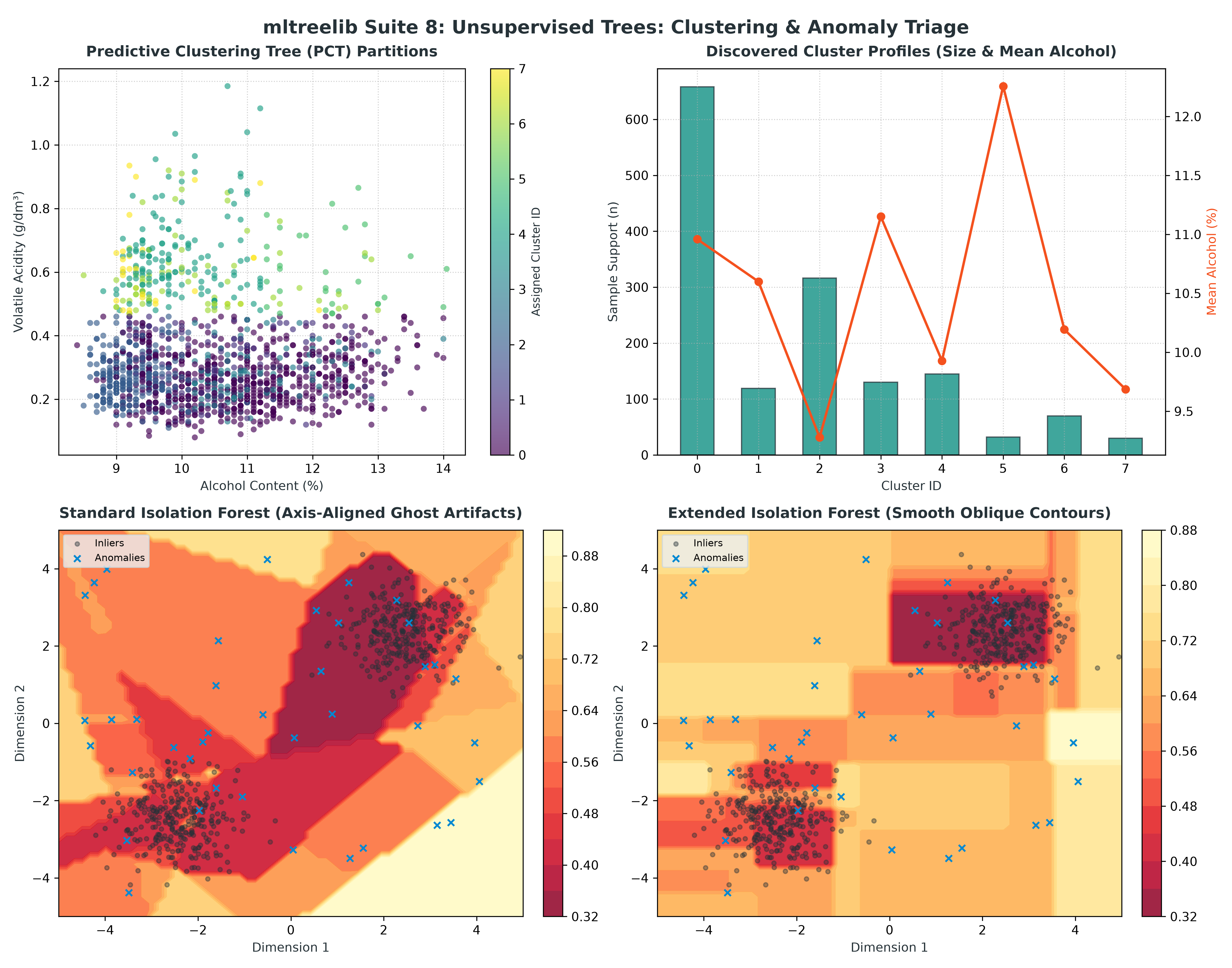
Discovered clusters: 8

=== 2. Extended Isolation Forest vs Axis-Aligned Isolation Forest ===
Generated 2D mixture: 600 inliers (2 clusters), 40 peripheral anomalies.
Outlier sample anomaly scores:
  Axis-Aligned IF : [0.590, 0.531, 0.479, 0.590, 0.590]
  Extended IF     : [0.590, 0.709, 0.597, 0.751, 0.590]
Key Quantitative Findings
- Auditable Cluster Profiles (Panels 1 & 2):
ClusterTree(kind="pct")automatically isolates distinct chemical cohorts (such as high-alcohol/low-acidity dessert wines vs dry table wines) with exact bounding rules. - Elimination of Ghost Anomalies (Panels 3 & 4):
- In Panel 3, standard axis-aligned Isolation Forest produces artificial cross-shaped grid ridges between the two normal clusters where empty space is falsely flagged as anomalous.
- In Panel 4, Extended Isolation Forest's oblique cuts produce smooth circular density contours centered strictly on genuine sample density.
- Outlier Discrimination: EIF elevates anomaly scores for true peripheral outliers (up to 0.751) while keeping inliers below the 0.50 contamination boundary.