Compare anomaly review budgets
The Shuttle anomaly pathway makes a 5% review queue. This example asks how the apparent precision and recall change if the team can inspect 1%, 5%, or 10% of a batch. It uses the same fitted score for all three policies.
Use the Shuttle files and fit block in the pathway. The extended script reproduces the same score and budget curve directly.
Score a batch once
After the pathway's scores and y_test assignments, use this block to compare budgets. Define and freeze the operating budget on development data when making a performance claim.
from itertools import accumulate

truth = [int(label != 1) for label in y_test]
order = sorted(range(len(scores)), key=lambda i: (-scores[i], i))
hits = list(accumulate(truth[i] for i in order))
for fraction in (.01, .05, .10):
    budget = max(1, round(fraction * len(scores)))
    found = hits[budget - 1]
    print(budget, round(found / budget, 3), round(found / sum(truth), 3))
The budget fixes how many rows enter the queue. The score ranks the records, then source order breaks ties. Keep the same budget and tie rule when comparing a new scorer with a baseline.
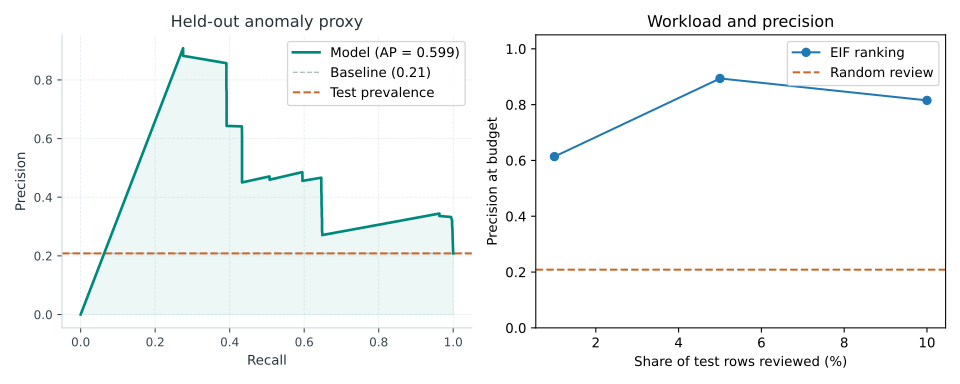
| Test records reviewed | Precision | Recall |
|---|---|---|
| 145 (1%) | 0.614 | 0.030 |
| 725 (5%) | 0.894 | 0.214 |
| 1,450 (10%) | 0.815 | 0.391 |
Precision rose from 1% to 5% for this ranking. Precision at a budget need not decrease smoothly as you add cases. Check score ties and the composition of the queue before expecting that pattern again.
Check the label before using the curve
Test precision here uses non-class-1 operating states as a labeled proxy. In an actual review queue, collect reviewer outcomes and a random sample outside the queue. The random sample gives evidence about what the queue missed. Compare the ranking with an existing rule or a random-review baseline at the same budget.
The unified AnomalyTree interface exposes both scoring and thresholded predictions. Use score_samples() for a fixed workload. If using predict(), monitor the actual queue size because a training cutoff does not enforce a fixed budget in a new batch.